
by Joseph P. McGuire, PhD, Emily J. Haas, PhD and Lucas Simpson, M.Ed., GSP
Technological development and innovation across the industry show no signs of slowing, bringing to the forefront effective adoption and use. Regardless of the technologies that workers use in the workplace, the basic principles of human-centered design and integration have remained the same: involve workers early and often [1-3].
For example, technology integration case studies conducted by the National Institute for Occupational Safety and Health (NIOSH) consistently found that tailoring communication and training to workers’ existing perceptions and experiences reduced barriers and timelines to adoption [4, 5].
Follow-on research showed that when workers are involved in pilot applications, technology can also serve as an intervention to support learning and proactive decision-making [6]. We deduced that a similar outcome may emerge regarding the use of generative artificial intelligence (AI).
This article describes why and how safety trainers may consider leveraging generative AI not to build their training but rather, to facilitate content in a way that can involve everyone while fostering critical thinking and aligning with organizational safety priorities.
To this end, we present a case study that describes an eight-hour Mine Safety and Health Administration (MSHA) annual refresher training (ART) that integrated generative AI to initiate safety questions at the boots-on-the-ground level. Based on this pilot, we offer reflections for those who are seeking to update training approaches.
Worker Engagement in Safety Training and a Potential Role of Generative AI
In a NIOSH safety climate study [7], worker engagement was a significant predictor of safety proactivity and compliance, but employees tended to have lower perceptions around this topic. Based on these results, many participating companies leveraged participatory-based safety efforts – many of which have been published in Rock Products, sister publication of North American Mining.
One of these initiatives, first introduced with asphalt and aggregates employees during an ART, prompted them to answer, “What are the biggest safety-related issues or problem areas that might be affecting our safety culture?” [8, 9]. Topics were grouped by theme and written on large sheets around the training room. Each employee received five sticky notes to vote for issues that needed more attention on their site, allowing everyone to visually identify and prioritize areas of perceived importance.
Among the most frequently cited issues were poor or inadequate communication, lack of training, and failure to speak up [8-10]. This approach not only validated worker concerns but also helped senior leaders identify systemic challenges across job sites. Importantly, rather than relying solely on top-down interventions, companies used the feedback to empower employees to co-lead change. Interventions stemming from these brainstorming activities have included bystander intervention programs [10, 11], powered haulage management systems [8, 9], and employee-led safety committees [12].
We summarized this training activity for a couple of reasons.
- First, success in using an informal fishbone approach (e.g., a way to visually brainstorm and visualize ideas) [13-15] during ART may be useful for trainers if they face challenges with a quiet group or if the current culture is stifling open communication.
- Second, effectively facilitating this exercise is time-intensive for trainers and reaching actionable solutions can be difficult to achieve [15].
- Last, while these ongoing discussions are effective and often preferred by trainees, trainers may find it difficult to
capture and respond to feedback while staying focused on the learning objectives [16]. With the emergence of generative AI, however, trainers may use it to augment training by supporting dialogue and more quickly making sense of feedback.
Although generative AI has been discussed as a tool that could alter or streamline workers’ jobs or tasks in the future [17], to our knowledge, it has received little attention as a way to engage workers. Previous research has shown that introducing new software technology does not guarantee acceptance unless it is introduced and discussed in ways that make it relevant to the workers who will use it.
This was the case for real-time dust exposure assessment interventions and virtual hazard recognition training that allowed workers to actively identify and mitigate their risks [6, 18-19]. These technologies have become a catalyst for open communication and ownership over personal safety. To this end, we were curious if using generative AI in a similar way during ARTs could enhance workers’ participation in safety-focused discussions. This exploratory concept was piloted during a recent ART at Patriot Crane and Rigging, a Nebraska-based contracting company that performs work on several mine sites.
Case Example with Patriot Crane and Rigging LLC
Patriot Crane and Rigging specializes in overhead hoist, crane/rigging, and heavy hauling. They employ approximately 130 people who serve as operators, drivers, service technicians and millwrights. Because their services are contracted by mine operations, employees complete MSHA Part 46 or 48 New Miner and Annual Refresher Training. Corporate Safety Coordinator Rob Green tries to bring in training beyond typical PowerPoint lectures including hands-on activities like gamification, group discussion, and videos. When scheduling this year’s 2025 MSHA ART, he agreed to try something even more different, if his employees were open to it.
So, the day began by giving workers two choices regarding their training and how it would be delivered: 1) Same as in the past, using an educational guide and slides, or 2) Experiment with something new.
Workers selected the second choice. Workers were first asked to develop a list of safety-related topics that they wanted to learn more about. Listed topics focused on standard operating procedures (SOPs) for a variety of tasks, including work in hot temperatures and other weather-related events, blasting operations, lockout/tagout/tryout procedures, and conducting workplace exams or equipment inspections. Other topics were how to interact with MSHA Inspectors and MSHA’s personal protective equipment and ladder safety requirements.
Topics were recorded on easels in the room. Like the fishbone approach previously discussed, workers received sticky notes to vote for the topics they wanted to know more about. The eight topics with the most votes were selected to be covered in the training (i.e., 45–60 minutes per topic). Generative AI (Microsoft Copilot) was introduced to help cover these topics. After a quick demonstration of the generative AI tool, workers were asked to develop topic prompts and follow-up questions based on the information output.
At the end of the day, workers were instructed to generate prompts that captured safety-related scenarios routinely encountered on the job. Examples of their job roles and respective prompts included:
“I set up jobs on mine sites. What should be covered in workplace exams when working on a new mine site?”
“I am a service tech. Help me troubleshoot the problem with an air conditioning system on a crane that is only blowing hot air. This is a mechanical and safety issue.”
“I am an operator who routinely inspects equipment. What are the most overlooked things when doing an equipment inspection?”
“I’m a service tech who needs to provide a bid estimate for removing and replacing an engine in a semi-tractor. Give me a bid for this and then redo the bid to include all the itemized components attached to the engine (turbo, air conditioner, etc.).”
These examples show how trainers and the participating operators, drivers, millwrights and service technicians did not just attend a required ART but took control over their learning outcomes in the co-design of it.
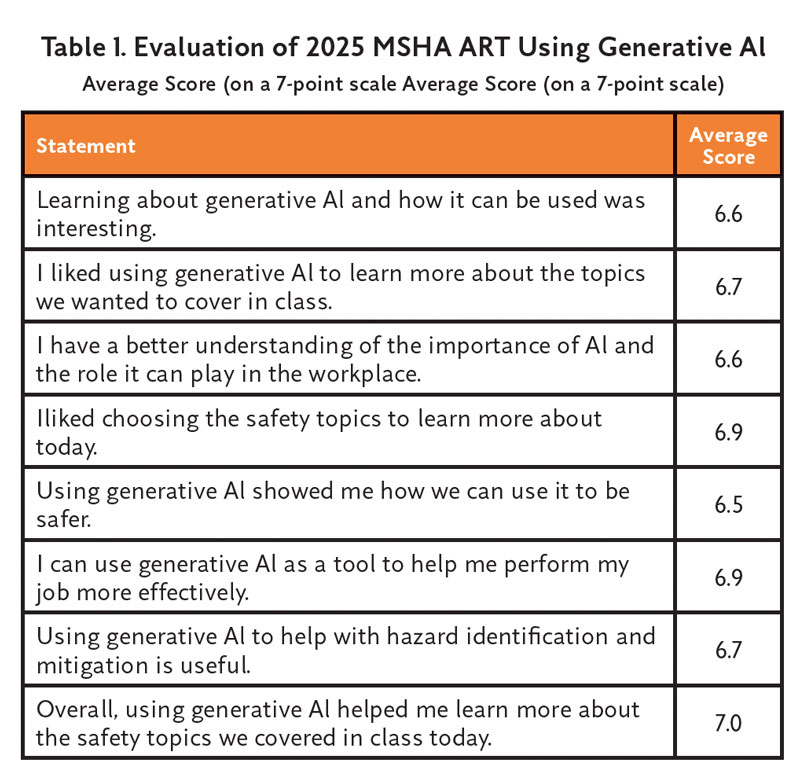
As usual, workers completed an evaluation of the training. One set of questions focused on the use of generative AI (if applicable to ask). The questions used a 7-point Likert Scale with seven being more favorable (Table 1).
The results provide initial support for trainers using generative AI in this way. Although some closed-ended questions asked about the inclusion of generative AI, the open-ended questions did not. However, many workers noted the perceived value in using it as a tool to enhance the training and their own safety practices. Some of these open-ended responses are expanded upon in our initial takeaways below.
Initial Reflections and Lessons Learned
This case example offers considerations for industry leaders and trainers. First, while the use of technology in training is not new, what stood out in this case example was the consistent engagement throughout the day. When asked what they liked best about the training, many workers noted that using generative AI helped them to stay involved because they did not always know what was coming next.
Another recurring theme was that generative AI prompted them to think about safety before tasks started. Workers reflected on how the back-and-forth prompting nudged them to consider more safety issues in their daily routines and anticipate potential risks.
Beyond hazard identification, workers anecdotally shared that using generative AI was surprisingly helpful in navigating non-technical aspects of workplace safety. Examples shared were preparing for MSHA inspections, interacting with MSHA inspectors, or navigating a difficult conversation with coworkers. In the future, this type of format could be used in trainings with managers to support communication or coaching skills.
Of course, this pilot was not without challenges. It took time upfront to explain generative AI to everyone, discussing the importance of data privacy and ethics when developing specific prompts. This being the first time generative AI was used, the conversations also moved quickly. In the future, establishing projects within a generative AI platform and exporting text and notes for editing in real time can help navigate the flow of conversations.
Also, for workers who were not familiar with generative AI, it was important to discuss the current limitations of these large language models and that the output is not a replacement for human judgment in the field.
For example, it is worth noting that, although all survey responses were extremely high, trending at 100% agreement, the item with the lowest score was in response to “Using generative AI showed me how we can use it to be safer.” Although many workers reflected on the safety-add this tool can provide, there was a subtle recognition that it cannot and will not protect workers. Individual judgement along with collaborative problem solving and decision making are still primary drivers of safety on site.
Beyond the Classroom
Several evaluation comments shared insights beyond training applications. Workers expressed a realization that generative AI could be used to help them stay focused on field work while still fulfilling compliance responsibilities.
For example, in response to the question “How will the topics discussed in today’s training be incorporated into the tasks you do when you return to the jobsite?”, several workers wrote that using generative AI could help them with administrative functions, which, subsequently, would help them stay in the field where time is better spent. Some feedback expressed an interest in trying to embed generative AI tools into already-existing processes (e.g., hazard ID, tailgate talks, near-miss reviews) to help reinforce pre-task planning and situational awareness.
The Trainer’s Perspective
The first author of this article did not use generative AI to develop this training; rather, it was used as a tool to engage workers and more quickly facilitate the direction of the training. By asking workers to select safety topics relevant to them and design prompts to advance the discussions, the trainer observed a strong sense of ownership. This could be in part due to the personalized approach to the training, which would have been more difficult without generative AI.
We have written previous articles about the importance of trainers stepping outside of their comfort zone to enhance workers’ training experiences [20-21]. We also know the discomfort that can be associated with this; however, generative AI could function as a crutch to those who may not be comfortable deviating from already prepared material.
Also, by providing space to explore more content, trainers may have an easier time moving past a typical lecture-style training and try to facilitate larger group discussions. From the first author’s perspective, entering and re-entering various prompts in real time freed up cognitive space to dialogue and discuss way more than would have been possible without using this tool.
Conclusion
At the beginning of this article, we discussed previous technology integration research and the potential value of involving workers prior to sitewide deployment. Although we do not have a baseline, anecdotally, the first author observed that the use of generative AI in the training helped to demystify its potential use and showcase its accessibility.
Like previous technology integrations, this learning-by-doing in a low-stakes environment could be one approach used by companies that are considering new digital solutions. Finally, when it comes to training development, generative AI has been used to produce updated images and scenarios for more realistic training – one recent example being in the fire services [22]. However, the authors could not identify use cases of generative AI as a training aid to support worker engagement and critical thinking. Although more case examples are needed, initial feedback indicates a value-add for worker involvement and learning during an eight-hour training.
Acknowledgement: The authors thank Patriot Crane and Rigging LLC and the Corporate Safety Coordinator, Rob Green, for being open to this pilot training approach and allowing us to share initial reflections with the industry.
For full disclaimers and reference citation information related to this article.